Video games make good teachers. Sometimes.
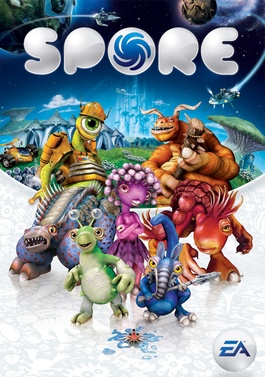
My six-year-old recently explained to me the need for certain species to adapt to their environments in order to survive. He gave me a detailed explanation of how sometimes creatures will have parts that don't work well in an environment and they'll die, and other times, they'll have parts that help them and they'll live and reproduce. He went on to speculate about how a bird we saw flying by the car (this is what brought on the train of thought) probably adapted to live in our desert. While his imaginings were clearly those of a six-year-old's creativity, I couldn't help but be impressed by his knowledge of how species eventually evolve. I asked him if he learned about it in his kindergarten class. His response? "No, I learned about it in Spore."
A video game.
Apparently, he had a species he created die because it wasn't well-suited to its environment, and another one become successful and evolve into higher species. He also understood a fair amount about the food web, ecosystems, and the benefits of societal connections.
All because of a video game. And let's not get me started on what he explained to me about how to build things in Minecraft and all that was implied in that explanation. Or his detailed description of physics concepts, courtesy of Portal. (He's a rather stream-of-consciousness conversationalist...)
I've been following the idea of gamification in the classroom for several years now, and I've read a lot along the way. Although I've yet to come to a solid conclusion about the topic, my six-year-old's surprising understanding of fairly complex ideas made me realize that games just might be a way to help teach our students.
Gamification has its fans and its detractors (and its pros and cons), but at the end of the day, I think it's like pretty much everything else in education: use it as a tool, and use it with purpose, and it has the potential to benefit a classroom greatly; use it without a clear purpose or in place of solid instructional practices, it becomes just another thing that doesn't work (or doesn't work for long).
There are two basic models of gamification: simulation games and structure games. Simulation games require students to learn or apply content knowledge to "win;" structure games turn the classroom environment itself into a game. Check out this blog for a more in-depth description, as well as a discussion of Classcraft, which is a type of structure game.
One of the earliest articles I read on gamification revolved around Classcraft, but before it was available as a product (it was under development at the time). Unfortunately, I can't seem to dig that article up, but the essence of it spoke to me. The creator of Classcraft started out in his own classroom. He enjoyed World of Warcraft (those less in touch with the gaming world can read about it here), and he was also a fan of Dungeons & Dragons. He decided to take some of the features he liked about the game and translate them into class. He used his own class to figure out some of the perks and pitfalls of the process, and eventually he decided to turn it into a game other teachers could use. This article provides more of the back story, but also sounds a little like an advertisement for the game. It's definitely not the article I read originally, but it does explain a bit about the game and how it came to be.
Classcraft is a gaming platform that teachers can use to turn their own classrooms into gaming environments. While Classcraft is just one of many possible choices (in addition to creating an original game), it serves well as an example to discuss. Here's my take on the idea of this particular version of gamifying the classroom:
- Pros:
- Classcraft has students working in teams. It requires collaboration and accountability in order to make progress. The real-world benefits and consequences for classroom performance should help students make the connection between virtual teamwork and real-world teamwork, and hopefully help them become better prepared for life after school (when communication and collaboration are valuable life skills).
- Classcraft capitalizes on the natural tendency of people to want to learn and explore. If a teacher uses Classcraft as a tool to help motivate students to explore content (rather than just as a way to monitor whether a kid did his/her homework), it becomes an opportunity to see/earn a reward for learning. If the game is used in conjunction with compelling lessons and quests for knowledge, the process of learning is something that is enjoyable and fun, whether or not there's a reward at the end. The badge/level up/reward is just an outward symbol of completing something that was fun to do.
- Used intelligently, this game (or systems like it) has the potential to make students' grades more real to them. The vast majority of today's students play at least some games; they all seem to understand the value of leveling up, earning badges, completing quests, etc. While some students might not care whether they earn an A or a C in a class (or truly understand the difference between the two), they all seem to understand making progress in a game. If progress in the game is equated with grades, students in this environment have a much better chance of understanding how they earned the grade they receive at the end of a course.
- Cons:
- Because students are required to work in teams, a class with a high number of unmotivated students could sink the experience for everyone. I suspect in most cases, the unmotivated students would respond to pressure from classmates to perform better so they can make progress; however, with the wrong balance of motivated and unmotivated students in the class, this could become an exercise in frustration for the motivated students, and they may eventually give up, lose interest, or --even worse-- stop working themselves, because they can't make progress. A teacher really has to know his or her class and be able to connect with them to be able to use this sort of tool effectively.
- Some students are only going to participate for the opportunity to win badges/prizes/points, and not really make the connection with what they're learning. If they're only working to complete the quests for the prizes, they're not building up the habits that will make them lifelong learners. It is possible that those students who start with the extrinsic motivation may eventually become accustomed to searching for knowledge and eventually become intrinsically motivated (that's the beauty of what a well-designed assignment can do in this setting), but it isn't necessarily going to be the case. I do suspect the those motivated by the prizes are probably the most likely to not do to work in a non-gamified classroom, so in some cases, just giving them a reason to complete the work should be considered a win for education.
- I suppose this is less of a con than a point to consider. Using a game like this in the classroom really requires thoughtful lesson planning. If this is used as an add-on to a standard "sage on the stage" classroom, it might work to engage kids a little more in what they're doing. Its real power to make a difference, though, is in a classroom where the teacher has taken the time to move away from lecture/test/repeat to a project- or problem- focused class that invites students to uncover important information as they find a solution to a carefully crafted problem/project. Teachers without the time or motivation to make a move to a student-centered learning environment might find this type of gamification to have little to no impact on learning in the long run. Platforms like Classcraft invite teachers to more carefully craft their classes.
Regardless of the type of game or platform, gamification provides the opportunity for teachers to engage their students in learning in a way that is familiar to the students. Like any opportunity in education, it is the responsibility of the teacher to figure out the best way to use it and whether it's appropriate for a particular teaching assignment. While gamification may be a perfect fit for one class or teacher, it might end in disaster for another. Teachers interested in gamifying their classes have to be willing to do what their students do every time they play: risk failure.
Perhaps gamifying the classroom is a game in itself.

Thank for you post. I have never heard of Spore or Classcraft and now in reading your post I have a better understanding of both. I believe that games have their value in the classroom but can also be misused. I have a follow teachers that use games in replacement of teaching and do it often. Just like you wouldn't use a TV to babysit your kids, you don't use games to teach your students.
ReplyDeleteI agree that you don't want to use games in lieu of actually teaching. It's a little like using the flipped model: if you want to try it, know how it's going to make your classroom better and allow you to provide better instruction for your students. Using tools like these should enhance what teachers do in the classroom, not replace it.
Delete